Mind your surroundings



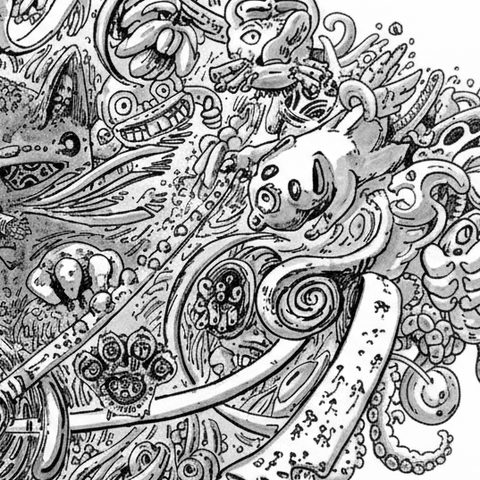
When a strong vibration arrives as sound, awareness narrows and shoots — like a well-aimed arrow — straight to the source. The mind starts “minding” around it with the mechanism we built for ourselves. One person’s whole body jolts; another calmly turns; another walks on as if nothing happened. My cat barely wiggles an ear in his sleep when I shut the door, while my mother can feel terror from another room. You can guess which of them was relaxed and which was tense.
Relaxation changes everything. Fully relaxed, we can move awareness through the body at will, undisturbed by the noise around us; emotion connects naturally with perception, and our inner life flows without tension. A bird minds its surroundings in flight — always looking, always relaxed. We move through concrete jungles bounded by rules — crosswalks, roads, stations, shops — because many people have to share the space safely. We even built places for specific kinds of awareness: theatres and halls for the mind, sports halls for the body, festivals to dance and meet.
Minding our surroundings must happen consciously through at least one of the senses to give us the feeling of safety. When we lose contact with our surroundings completely, restoring it feels like waking from a dream — everything is a surprise.
Our sense of speed and distance is relative to where we stand. On a bike, moving between people, others seem to move slowly and the path is easy to read — I can stop in under a second. On foot, a cyclist coming toward me feels much faster, and I tense my legs because I can’t predict the line. Nothing about the two people changed; only the frame did. Most friction with our surroundings is this kind of mismatch — and after the surprise passes, the universe always offers a moment of quiet. Use it to contemplate, and next time the situation finds us more prepared. Choose comfort instead, and we meet the same surprise again, unchanged.
Consider that everything we perceive already happened a moment before we interpret it and feel it. When we are tense and unaware of the body, the smallest whisper can rattle us. When we are relaxed and fully aware, we perceive and feel more in the same span of time — and every moment dilates. That is how we create more conscious experience in a life.
The speed of light shapes our sight, the speed of sound our hearing, the myelination of our nerves the speed of our thinking. Through the Webb telescope we can see stars as they were hundreds of millions of years ago; turn that the other way, and the delay between our immediate surroundings and our inner response can be unimaginably small. Distance and speed are concepts of the mind — useful when understood, useless when merely known as words.
The classic example: did you lock the door after you left? Do you actually remember locking it — or are you remembering some other time? Most people answer with a flicker of tension. After a moment of unawareness, our intuitive trust goes numb, and a numb mind is easier to manipulate.
I am poor at recalling what people said. But I once met a man who could reproduce an entire conversation, word for word. He couldn’t explain how — I worked it out later. When he listened, his muscles were relaxed, including the vocal cords and the diaphragm. With those quiet, sound can be perceived more consciously. Anyone can learn to stay continuously aware of what reaches the ears — and the same is true for sight, touch, movement, scent, and taste.
In meditative practice the focus is the breath — more precisely, the movement of the diaphragm, which sets the pace of the heart and follows our calm. If awareness rests on the diaphragm and the heart, every perception and emotion has something to bind to, and life becomes a more continuous moment of awareness. The quality of awareness — what we might call intelligence — decides the quantity of conscious experience over time.
Try this:
This shows you what, where–when, and how hearing actually happens. It is a long road to guiding an orchestra — but you are on it. Until then, keep this around your ears.
So where are we, after all this minding? The closest answer I have is that we are awareness — and awareness happens through the nervous system. It becomes consciousness only when we willingly connect what we perceive with what we feel. It is a continuous dance of experience and manifestation: emotion felt as experience, experience manifested as emotion; perception working both ways. A dance of consciousness and unconsciousness, yin and yang, with no fixed beginning or end.
Minding is healthy when it stays relative to both perception and emotion. That is how we build a conscious life. Ignore either one, and unconsciousness grows, spinning illusions in its path. We have our surroundings to care for — let us mind them well.